


By QUEST MB
The Debt Management Office’s (DMO) most recent data on public debt shows that Nigeria’s total external debt stock increased by 3% QoQ to US$48.5bn in Q3 2025. On a year-on-year (YoY) basis, the total external debt stock expanded by US$5.4bn, or 13% YoY, relative to Q3 2024.
Although the figure primarily consists of debt owed by the Federal Government of Nigeria (FGN), it also includes a smaller portion owed by the 36 states of the federation and the Federal Capital Territory (FCT), for which the FGN provides sovereign guarantees.
The FGN’s share accounts for roughly 90% of total external debt, with the remaining 10% owed by state governments and the FCT. In standardised terms, the total external debt stock is equivalent to 16.1% of 2025 GDP.
- The marginal QoQ expansion in external debt was mainly driven by a US$1.2bn increase in project-linked syndicated loan disbursements to almost US$1.4bn.
- In terms of split, a large proportion, 61% of the debt stock, consists of debt owed to multilateral and bilateral lenders on concessional lending terms, while the remainder comprises market-related debt
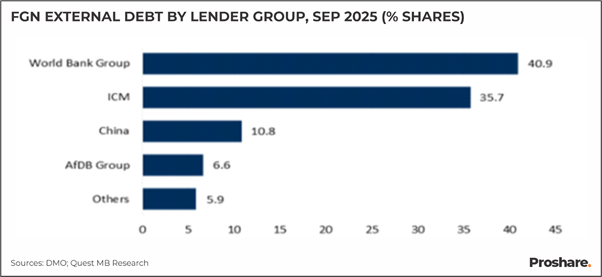
- Loans from the World Bank, which accounted for 41% of the total external debt stock, increased by around US$159m QoQ to US$19.8bn.
- Disbursements by the African Development Bank (AfDB), the second major lender, also increased by US$31m to US$3.2bn (c. 6.6% of total).
- Debt owed to bilateral lenders also increased marginally by US$112m to nearly US$6.7bn, with China contributing a substantial US$5.2bn.
- Nigeria’s Eurobond maturity profile remains light in 2026, with no redemptions due this year and the next US$1.5bn maturity scheduled for 2027.
- Looking ahead, we expect a continued, steady rise in Nigeria’s external debt stock.
- Notably, the FGN has a budget deficit of around N25trn, of which an estimated N3.6trn is expected to be financed through new external borrowings.
- To help narrow the funding gap, the FGN is also considering the sale of select state-owned assets as part of its financing strategy (see chart below)