
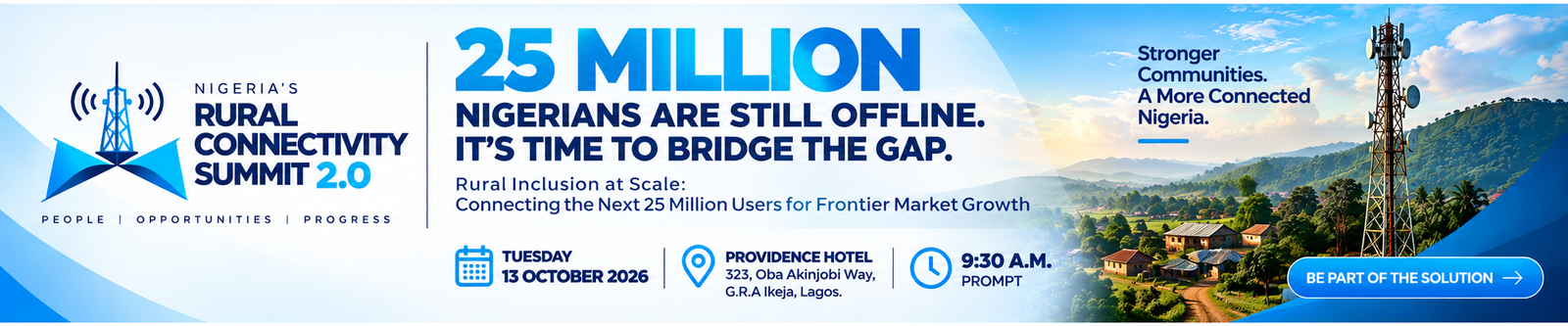



Global Independent Connect Limited (GICL), a subsidiary of IHS Towers Nigeria, has announced significant progress in its drive to deepen broadband penetration and digital inclusion across the country.
The company’s Vice President, Olabode Ojo, disclosed this was achieved with over 600 rural connectivity sites already deployed and more than 16,000 kilometres of fibre optic cables being rolled out nationwide.
He stated this during the Design Workshops – Building Productive Sectors: Investing in the Digital Economy session at the 31st Nigerian Economic Summit (NESG) held in Abuja.
He said GICL’s investments are designed to extend network coverage and digital access to underserved and unserved areas, thereby advancing Nigeria’s digital transformation agenda.
“At GICL, we are building the foundation that supports Nigeria’s digital economy,” Ojo said. “Our focus is on strengthening connectivity infrastructure—laying extensive fibre networks and deploying sites that power technologies like 4G and 5G—to enable services such as financial inclusion, remote healthcare, digital learning, and smart agriculture.”
According to him, GICL’s rural rollout now spans 26 states, offering 2G, 3G, and 4G services to communities that were previously off the digital grid. These efforts, he noted, are helping to narrow Nigeria’s connectivity gap and empower millions with access to essential digital tools.
“Many people in rural areas can now use mobile platforms for education, health consultations, and financial services,” Ojo explained. “These are not just communication projects—they are enablers of social and economic growth.”
Ojo also praised recent government initiatives, including the Federal Ministry of Communications, Innovation and Digital Economy’s plan to deploy 90,000 kilometres of national fibre infrastructure and establish 7,000 rural telephony sites, saying GICL stands ready to partner with government and other private players to achieve those targets.
“These are bold but realistic goals,” he said. “The private sector is ready to play its part, and collaboration across all stakeholders is the only way to make universal access a reality.”
He added that although agriculture is not GICL’s core business, the company recognises the role of connectivity in boosting productivity in the sector—enabling farmers to access market data, weather forecasts, and financial services through digital platforms.
Ojo expressed optimism that continued investment from both public and private sectors will accelerate the growth of Nigeria’s digital economy and unlock new opportunities for innovation, inclusion, and prosperity.
“With sustained collaboration and commitment, Nigeria can build one of Africa’s most resilient digital ecosystems,” he said.


