
Education
How FUOYE Attains Historic Milestones under Professor Fasina as VC

Published
1 month agoon
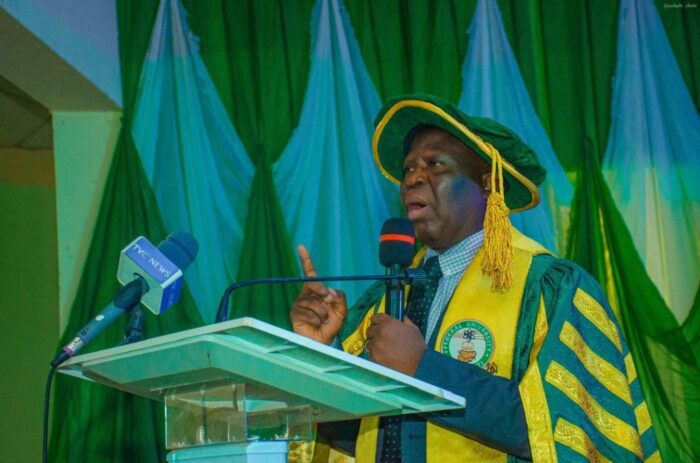
When Professor Abayomi Fasina took office as Vice Chancellor of the Federal University Oye Ekiti in 2021, the Nigerian university system was navigating one of its most testing periods in recent history. Public institutions were grappling with fragile funding structures, disrupted academic calendars, mounting enrolment pressure and rising expectations from a youthful population hungry for opportunity.
For a young federal university that was barely a decade old and still shaping its institutional character at the time, the need for an ambitious and methodical leadership was imperative.
Read Also:
At the close of his tenure five years after, the record of Professor Fasina’s stewardship transcended just a catalogue of projects to amplify a narrative of structured growth, institutional confidence and deliberate reform, anchored in a clearly articulated vision that sought to reposition FUOYE within Nigeria’s distressed education landscape and beyond as the institution is now recognised among fastest-growing universities in Africa.
A Strategic Agenda in a Constrained System
According to members of the university community who witnessed the administration at close quarters, as well as external stakeholders, Fasina’s framework immediately provided coherence for FUOYE and averted policy discontinuity and derailment after the leadership transition. Over the five-year period, all elements of the agenda were reported as achieved to varying degrees, with outcomes measured both physical infrastructure and in institutional processes and planning culture.
At his investiture, one of the defining priorities for the institution was financial sustainability. Five years later, the university recorded a 310 per cent increase in internally generated revenue. This was driven by the establishment of ventures such as the university printing press, bakery, farm and water production facility, alongside the expansion of part time programmes, affiliated colleges and the creation of the FUOYE Business School.
Fasina’s aggressive diversification for sustainability contrasts sharply with what obtains in the wider Nigerian context, where many public universities remain heavily dependent on federal subventions with very minimal efforts towards self-reliance.
Alongside revenue growth, the university pursued expansion through student enrolment in parallel with programme development. In his valedictory remarks during the recent convocation ceremonies, Professor Fasina announced that FUOYE had emerged as the fourth most subscribed university among 303 institutions nationwide, based on the latest Joint Admissions and Matriculation Board application statistics.
This growth was supported by the introduction of professional and innovative courses, increased admission quotas and a rapid expansion of academic offerings. Between 2021 and 2026, the number of faculties rose from eight to 18, while academic programmes increased from 73 to 91. Departments expanded from 61 to 81 and directorates grew from just only one to 19, reflecting an institution in accelerated and deliberate build up.
Academic Output, Rankings and Research Visibility
A central measure of any vice chancellorship is the quality and visibility of academic output. Under Fasina, FUOYE invested deliberately in research policy, capacity building and international collaboration. The university established its first comprehensive research policy, created a Centre for Research, Innovation, Creativity and Grantmanship and appointed a Deputy Vice Chancellor dedicated to strategic partnerships, research and linkages. Research training was extended to all academic staff, while collaborations were forged with universities and institutions across Europe and beyond.
These efforts translated into tangible outcomes as 34 lecturers secured research grants and equipment valued at over N400 million, while a single grant attracted by a FUOYE academic from the Bill and Melinda Gates Foundation was valued at over $500,000. Additional research equipment worth more than $55,000 was also attracted to the institution, signalling growing research maturity and external confidence in FUOYE’s academic capacity.
Riding on these strengths, the university’s global and regional rankings reflected a steady upward trajectory. In 2024, FUOYE gained recognition in several Times Higher Education categories, including the Impact Rankings, World University Rankings, Interdisciplinary Science Rankings and the Sub-Saharan Africa Rankings. In its debut appearance in the Times Higher Education World University Rankings, the university ranked 20th among 21 qualified Nigerian institutions and was placed in the 1501 plus global band.
By 2026, FUOYE was ranked fourth in Nigeria overall and included in the World University Rankings by Subject for Physical Sciences and Social Sciences, placing within the 1,251 plus and 1,001 plus global bands respectively.
Infrastructure, Expansion and the Learning Environment
Just as outlined in the 21-point agenda, physical development formed one of the most visible aspects of Professor Fasina’s administration. Over 160 projects were executed within five years, ranging from academic buildings and laboratories to hostels, recreational spaces and administrative facilities. These included the Senate Building, a one thousand seat auditorium, the Freedom Park, a microfinance bank, faculty buildings, professional blocks, a computer-based testing centre and expanded laboratory complexes.
More than 30 classrooms were constructed, perimeter fencing completed and landscaping commenced. New hostels were delivered through both direct funding and public private partnerships, providing accommodation for thousands of students. This scale of infrastructural delivery positioned the university above the common experience of overcrowding that often accompanies rapid enrolment growth in public universities.
Specialised facilities also received attention with the establishment of drip irrigation fields and greenhouses at the Ikole campus to support agricultural research and commercial production, while the creation of the Institute of Food Security and Commercial Agriculture aligned academic activity with national priorities and attracted substantial federal support.
Human Capital, Welfare and Institutional Culture
Beyond buildings and rankings, Professor Fasina’s stewardship placed emphasis on human capital development and welfare. Over 200 professorial promotions were recorded within five years, alongside structured support for doctoral, masters and postdoctoral training. A total of 381 academic and non-teaching staff benefited from training and conference support, while 130 academic staff received sponsorship for advanced degrees.
Staff welfare measures included subsidised transport, fee rebates for staff children, reductions in sundry charges and timely promotion processing. Student welfare interventions ranged from subsidised shuttle buses and flexible fee payment arrangements to the completion of a Students’ Union Complex and the digitisation of student union elections. These reforms contributed to sustained campus peace and a predictable academic calendar, a recurring challenge in Nigeria’s public university system.
Documenting Leadership: Book Launch and Reflections on Stewardship
The culmination of Professor Fasina’s tenure was marked by the public presentation of his book, Holding the Rudder: My Years Steering FUOYE, which documents his leadership journey as the fourth substantive Vice Chancellor of the university from 2021 to 2026.
Speaking at the event in Oye Ekiti, the Managing Director and Chief Executive Officer of First Bank of Nigeria Limited, Olusegun Alebiosu, who served as chief launcher, commended the scale of transformation recorded under Fasina’s leadership. He described the university’s infrastructure expansion, enrolment growth and programme development as clear indicators of institutional progress, noting that the changes surpassed what he encountered during an earlier visit to the university. Alebiosu recommended the book as a reference material on leadership and institutional management.
The Pro Chancellor and Chairman of Council of FUOYE, Victor Ndoma Egba, a Senior Advocate of Nigeria, also praised Fasina for documenting his stewardship. He described the book as a practical guide for current and aspiring university leaders, adding that the incoming Vice Chancellor would benefit from the insights contained in it. According to him, “FUOYE is a university, but in many ways, a school of its own because what you will learn in Oye Ekiti, especially in management, you will not learn elsewhere.”
Reviewing the book, Professor Yisa Yusuf of Obafemi Awolowo University described it as a rare contribution to Nigeria’s limited tradition of institutional documentation. Quoting from the book, he recalled Fasina’s reflection that, “When I assumed duty as the fourth substantive Vice Chancellor of the Federal University Oye Ekiti, I did not walk into a position, I walked into a storm.” Yusuf noted that the metaphor captured the complexity of university leadership, from student agitation and staff relations to host community expectations and chronic funding constraints.
Responding, Professor Fasina said the book was not written as a defence of office, but as a reflection on leadership under pressure. He acknowledged the support of what he described as spiritual and destiny helpers and paid special tribute to his wife, Bosede Fasina, for her steadfast support throughout his tenure and the writing of the book. He also thanked the Pro Chancellor for upholding due process and institutional memory.
Graduation Outcomes and Institutional Maturity
Statistics of the last convocation statistics conducted by the university on Saturday, February 07, 2026 revealed a snapshot of academic output at scale in FUOYE. A total of 7,684 students graduated, comprising 7,396 undergraduates and 288. Undergraduate degree classifications included 131 first-class graduates and over 6,000 second-class degrees, reflecting both volume and academic spread across faculties. These figures, drawn from official convocation data, illustrated the university’s expanding role in producing skilled graduates for the Nigerian economy.
The establishment of new colleges, including Medicine, Computing, Cybersecurity, Software Engineering and Data Science, further signalled a shift towards labour market aligned education. Approval for the College of Medicine, including accreditation to admit students and access to clinical training facilities, represented a significant institutional milestone given the regulatory and infrastructural demands of medical education in Nigeria.
Legacy and the Question of Sustainability
As Professor Fasina exits office, the university he leaves behind is markedly different from the one he inherited in 2021.
While FUOYE has expanded in scale, diversified its revenue base, strengthened its research profile and gained national and international recognition, the question of sustainability of the traction remained a concern.
However, the new Vice Chancellor who just inherited the mantle of leadership from Adesina on February 11, Professor Joshua Olalekan Ogunwole, has assured that the university will not lose momentum on the growth path Fasina had set it.
According to the Ogunwole, FUOYE had achieved height under professor Fasina, thus, he would dedidate his strategies and policies for the next five years to building a strong base to strengthen the capacity of the institution to withstand its recent expansions.
His tenure, according to him, will be aligning growth with carrying capacity, sustaining infrastructure, deepening research commercialisation and managing multi campus complexity to ensure FUOYE remains sustain its trajectory as a leading university in Nigeria and Africa.
Last line
Measured against the realities of Nigerian higher education, Professor Abayomi Fasina’s stewardship stands as an exercise in deliberate system building. It reflects an understanding that university leadership is not only about expansion, but about constructing frameworks capable of outlasting individual tenures. In that sense, his five years at FUOYE form not just a record of achievements, but a reference point for purposeful governance within a constrained public system.
Share this:
- Click to share on X (Opens in new window) X
- Click to share on Facebook (Opens in new window) Facebook
- Click to share on WhatsApp (Opens in new window) WhatsApp
- Click to share on Pocket (Opens in new window) Pocket
- Click to share on Telegram (Opens in new window) Telegram
- Click to email a link to a friend (Opens in new window) Email
- Click to share on LinkedIn (Opens in new window) LinkedIn


