
Education
SPECIAL REPORT: Betting Shops, Alcohol Joints Closing In on Classrooms in Oyo Capital City

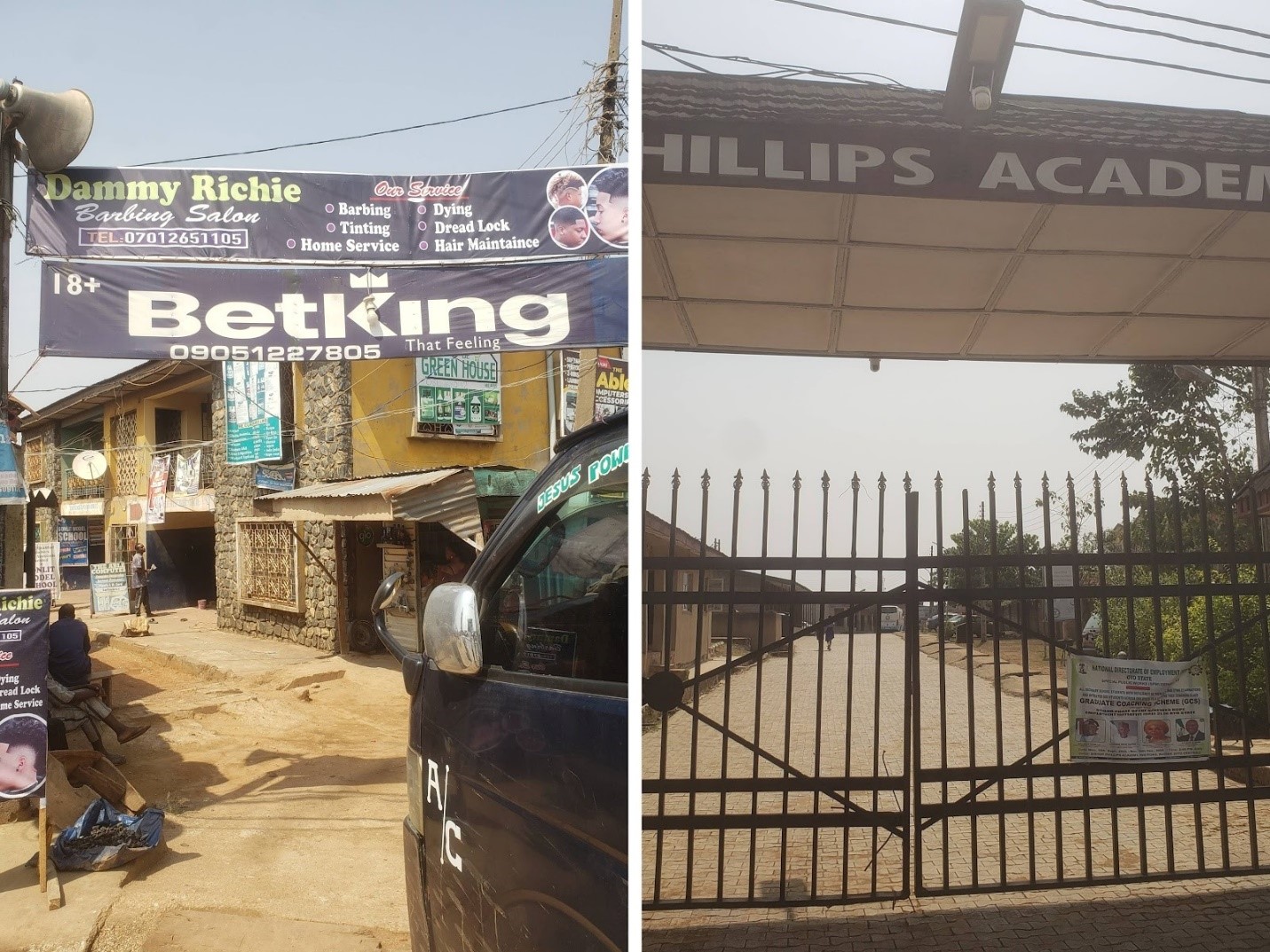
Across many parts of Oyo State, the growing presence of betting shops and alcohol joints near schools is quietly reshaping the daily environment in which students learn, Business Metrics reports.
Mariam* is only 14, yet the journey home from school already demands the kind of caution many adults learn much later in life. When the closing bell rings at Isebo Community High School in Alakia, Egbeda Local Government Area of Oyo State, she does not leave the compound immediately. She waits, sometimes for several minutes, until other classmates are ready to walk with her.
Her reason lies directly across the road from the school gate. A beer parlour that begins to fill with men long before sunset sits opposite the entrance, forcing female students to pass through a corridor of whistles, stares and remarks on their way home.
“They call us sometimes. If you walk alone, they will talk,” Mariam said quietly, her eyes fixed on the ground.
Most of the girls, she explained, have developed their own silent defence. They move in groups, keep their heads down and refuse to respond to the comments that follow them as they pass the bar. Looking back, they say, only encourages more harassment.

A beer shop opposite Isebo Community High School, Alakia.
Scenes like this are not isolated, as Business Metrics’ field investigation across several secondary schools in Ibadan reveals a pattern that is increasingly difficult to ignore.
Betting shops, alcohol joints and gaming centres are clustering around school environments, creating an atmosphere where students move daily between classrooms and spaces designed for adult leisure.
Education and safety experts warn that such proximity is not merely coincidental but carries deeper behavioural and social implications.
Lead Resource Person for Safe Schools Lagos, Dr Bisi Esuruoso, describes the trend as one that demands urgent regulatory attention, noting that the normalisation of gambling and alcohol consumption around schools makes such behaviour appear acceptable to impressionable students.
“When these activities become part of students’ everyday surroundings, access becomes easier, and the likelihood of experimentation rises significantly,” she explained.
Businesses closing in on school gates
Across many schools visited during this investigation, betting outlets or alcohol vendors were operating within walking distance of school entrances. In four of those locations, the businesses were less than 50 metres from the school gates.
Along the busy Iwo Road axis, Bishop Philip Academy sits opposite a sports betting outlet that attracts steady crowds of young men throughout the day. Neon advertisements promising quick winnings glow directly across from the school entrance.

A BetKing game centre directly opposite Bishop Philip Academy, Iwo Road
A similar situation exists at TL Oyesina Model Senior Secondary School in Monatan, where a small bar stands barely 30 metres from the gate, positioned along the path students use when arriving in the morning and leaving in the afternoon.
Students say the closeness of these businesses has begun to shape behaviour inside the school environment.
“Some students leave the school during break time to buy drinks or place bets,” said Tunde Gabriel*, a student of Bishop Philip Academy. “It affects their attention in class because their mind is on the games.”
Samuel Folarin*, another student in the same school, said sports betting has quietly become a routine activity among some learners.
“Many students play sports betting during lunch break. They earn little money, and their brothers or older friends encourage them that it is easy,” he said.

Some Bishop Philip academy students in front of Baba Ijebu Lotto behind the school fence.
Despite school rules banning alcohol and gambling, students say the temptation outside the school gates often proves difficult to resist.
Grace Ayoola*, a female student of Emmanuel College, said disciplinary measures have not completely stopped the practice. “Even when teachers punish students, some will still sneak out to buy alcohol,” she said.
Samuel added that after school hours, the activity becomes even more visible.
“On Fridays, after school closes, some of them go to the beer parlour across the road to buy alcohol,” he said.
From a safety standpoint, experts warn that such environments are associated with wider risks beyond indiscipline.
Esuruoso notes that areas with a high density of alcohol outlets around schools have been linked to antisocial behaviour, reduced academic concentration and increased exposure to crime, adding that similar patterns have already been observed in parts of the South West.
When celebrations become opportunities
Meanwhile, school celebrations, which are meant to promote culture and unity, sometimes create openings for students determined to bypass restrictions.
Modupe Boluwatife*, a student of Isebo Community High School in Alakia, said alcohol occasionally finds its way into events such as Asa Day celebrations.
“During Asa Day, some students hide small bottles inside their bags from home,” she explained, adding: “During valedictory, some SS3 students invite friends from outside, and a few people sneak in alcohol.”
Asa Day, widely celebrated across schools in the South West, is designed to promote Yoruba heritage through traditional attire, music, dance and local cuisine. Yet the closeness of alcohol vendors to school premises has introduced temptations that organisers rarely anticipate.
Peer pressure versus lure of quick money
Peer influence appears to be one of the strongest drivers behind student involvement in betting and alcohol consumption.
At Emmanuel College in Orita UI, Ayinla Sowande* admits that he began gambling after encouragement from classmates. For him, what started as curiosity gradually turned into a habit.
“I started betting in 2023,” he said. “I even taught most of my classmates how to play. At first, it was just for fun, but it became serious.”
According to him, the behaviour spreads easily among students who see it as a shortcut to quick cash. “Our seniors were the ones who started it and introduced it to us. They told us it was easy money, and many of us followed them,” he said.
Business Metrics learnt that family influence can also reinforce the habit. Ayinla recalled losing money alongside his older brother in a betting attempt that wiped out funds meant for a carpentry contract.
“I promised to stop yesterday after my brother and I lost all our money,” he said.
Even personal savings have not escaped the pull.
“Sometimes I use money meant for food or savings. Even the money I saved on Opay, I withdrew it almost immediately to play betting,” he admitted.
Stephen Oketayo, a senior student at Orita Basorun High School, believes the wider environment surrounding many schools plays a major role in shaping students’ attitudes.
“Many students get alcohol into school from our homes because of how our environment has exposed us to it. It makes it seem acceptable,” he said.

Orita Basorun High School, Ibadan
He added that minors are often asked by adults to purchase alcohol for them, which introduces curiosity at an early age. “Some area brothers even send minors to buy alcohol for them. This brings up the interest in the child to try it one day,” he said.
Hidden academic, health consequences
While some of these activities take place quietly, their consequences are beginning to surface. Oketayo said it is often difficult for teachers to detect which students are involved.
“You cannot easily know unless the person tells you or you see it yourself. Some of them act normal in class and still submit assignments. You only start noticing when their results begin to drop,” he said.
Olamide Adeyemi*, a student of Emmanuel College, said some learners are already experiencing health problems.
“Some students fall sick after taking alcohol or stressing themselves over betting losses. When they are not feeling well, they miss classes and cannot concentrate,” he said.
For others, the strain is psychological. Aisha Lawal, a student of Islamic High School, Basorun, Ibadan, described how gambling losses can linger long after the school day ends.

The betting shop is barely a five-minute walk from the Islamic High School, Basorun.
“Some of them stay up late thinking about the money they lost or how to get more,” she said, adding that “When the teacher is explaining in class, their mind is fixed on betting.”
Meanwhile, Esuruoso situated these outcomes within a broader child protection concern, describing the trend as both a physical and psychosocial security failure.
She notes that exposing students to such environments undermines their right to a safe learning space and increases vulnerability to risks such as bullying, sexual harassment and even recruitment into criminal or cult-related activities.

A betting shop around Islamic High School, Basorun.
Schools trying to hold the line
Not every school environment faces the same level of exposure, as in some communities, tighter supervision and fewer alcohol outlets nearby have helped limit the problem.
A corps member identified simply as Mr Noah, currently serving at Ajibode Grammar School, said strict monitoring has reduced the chances of students bringing alcohol onto the premises.
“It is not easy for students to bring alcohol into this school. The environment here does not support such acts,” he said.
According to him, students are not allowed to leave the school compound during class hours without permission, and local vigilantes occasionally patrol the area.
“Any student caught outside without permission were punished,” he said.
However, he acknowledged that structural weaknesses still pose risks.
“Yes, issues like cracked fences are points of concern because they expose students and can give them chances to leave the premises unnoticed,” he said.
Beyond school-level controls, Esuruoso emphasised that an effective response must extend to the wider community.
She notes that school authorities need to work closely with School-Based Management Committees and local stakeholders to monitor surrounding environments, while parents and community leaders must take responsibility for limiting children’s exposure and preventing the leasing of spaces near schools to high-risk businesses.
The legal gap in Oyo State
While Nigerian federal laws prohibit alcohol sales and gambling participation by minors, checks showed that Oyo State currently does not have specific legislation banning the sale of alcohol or the operation of sports betting or gaming centres within or around the environment of primary and secondary schools.
Under the Oyo State Physical Planning and Development Law, Section 60 empowers state planning authorities to regulate land use and prevent developments that may pose risks to public welfare.
Yet, the law stops short of setting clear boundaries for commercial operations near schools, offering no explicit prohibition for the proximity of bars, beer parlours or betting shops to learning institutions.
In practice, this means a school could be flanked by businesses that expose minors to alcohol and gambling without technically violating state planning regulations.
Federal laws, while clear in their intent, rely heavily on enforcement by local authorities and private operators. The National Lottery Act, for instance, states in Section 57(1) that “a person under the age of 18 years shall not be permitted to participate in any lottery.”
Similarly, regulations enforced by the National Agency for Food and Drug Administration and Control (NAFDAC) prohibit the sale of alcohol to minors. Yet, in the absence of a state-specific statute, these federal provisions are difficult to enforce in the school vicinity, where oversight is often minimal, and violators operate in plain sight.
The Child Rights Act, domesticated in Oyo State, provides additional protections with Sections 11(1) and 15(1) affirming every child’s right to dignity and safeguarding them from environments that may interfere with education or expose them to exploitation.
Meanwhile, complementing these statutory protections, the National Policy on Safety, Security and Violence-Free Schools, alongside implementation guidelines issued by the Federal Ministry of Education, set out expectations that school environments should be free from external hazards such as substance sales and gambling activities.
However, as Esuruoso points out, the challenge lies less in the absence of frameworks than in weak enforcement. Existing provisions, including environmental impact regulations and gaming licensing rules, already discourage the siting of high-risk businesses near schools, but compliance remains inconsistent.
Despite these directives, many of the guidelines are advisory rather than legally binding, leaving their implementation uneven across states.
In Oyo, this advisory status, combined with the absence of state-level legislation explicitly forbidding alcohol or betting shops near schools, creates a gap where federal protections exist in principle but lack practical enforcement.
In such contexts, federal standards serve as the benchmark. For instance, Nigeria’s legal drinking age is set nationally at 18, and selling alcohol to minors is prohibited. Yet local enforcement often depends on licensing and regulatory oversight, which is inconsistently applied outside formal scrutiny areas like city centres.
This regulatory gap means minors can often obtain alcohol with relative ease, especially in small sachets or bottles sold cheaply near schools.
NAFDAC provides fresh perspective
A nationwide survey released by NAFDAC on 3 March 2026, found that “54.3 per cent of minors and underage respondents obtained alcohol by themselves,” frequently from outlets selling the products in small, inexpensive packages that are easy to conceal.
The survey titled: Underage Drinking and Abuse of Alcohol: Access to Alcohol and Frequency of Consumption, further found that nearly half, 49.9 per cent, reported buying from retailers selling sachets and polyethene terephthalate bottles that have been central to debates over the accessibility of alcohol to minors.
Against this backdrop, experts argue that more decisive measures are required. Esuruoso advocates immediate zoning audits to identify schools exposed to such risks, stricter enforcement of setback rules and the creation of clearly designated child protection zones around school environments.
She also points to international models such as Kenya’s 300-metre alcohol-free radius around schools as an example of the kind of proactive policy response that could be adapted locally.
She maintains that without coordinated action involving education authorities, urban planning agencies, regulators and community stakeholders, the encroachment of high-risk businesses around schools will continue to undermine both safety and learning outcomes.
Government keeps mum
Efforts to independently get reactions from officials of the Oyo State Government proved abortive. However, as part of a team of newsrooms collaborating to report on the state’s education sector, we were in the room when persistent efforts by the leadership of DevReporting yielded a few minutes of conversation with the state’s Commissioner for Education, Segun Olayiwola.
Mr Olayiwola said he was busy and had no time “for a press interview”.
The commissioner, who acknowledged receiving what he described as “long questions” from DevReporting leadership, insisted that most of the things he reads in the news about the state’s education are lies.
After several attempts to speak with the commissioner, another comprehensive message was again sent to him, which as of Sunday, 5 April, was yet to be responded to.
Editorial Note: Names marked with an asterisk (*) are pseudonyms used to protect students’ identities.
This report was facilitated by DevReporting in partnership with Education As a Vaccine (EVA) and supported by the Malala Fund.


