
News
Nigeria’s Oil GDP Growth Rises to 7.31% as Production Recovers

Published
23 minutes agoon
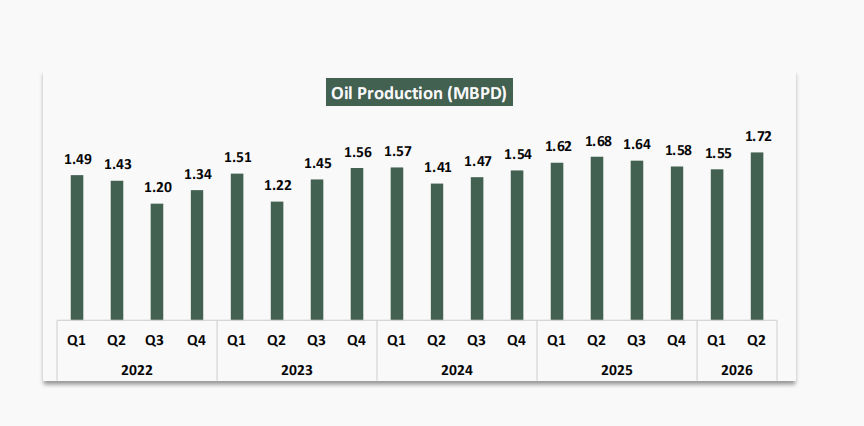
Nigeria’s oil sector expanded by 7.31% in the second quarter of 2026, accelerating sharply from the 2.13% growth recorded in the first quarter, according to the latest Gross Domestic Product report by the National Bureau of Statistics.
The Q2 performance marks a stronger contribution from the oil sector to economic activity amid a sustained recovery in crude oil production and efforts by regulators and operators to raise output.
Read Also:
The NBS report showed that the oil sector’s growth in Q2 was significantly higher than its performance in the preceding quarter, while overall real GDP expanded by 4.43% during the period.
The latest production figures from the Nigerian Upstream Petroleum Regulatory Commission provide further context to the recovery.
According to NUPRC, Nigeria produced an average of 1.505 million barrels per day of crude oil in July, while condensate production averaged 0.17 million barrels per day, taking combined crude and condensate production to 1.67 million barrels per day.
The July output kept Nigeria above its Organisation of Petroleum Exporting Countries quota of 1.5 million barrels per day for the third consecutive month.
However, the production recovery was not linear. July’s combined output declined by about 4% from the 1.735 million barrels per day recorded in June, when Nigeria’s crude production reached a 74-month high of 1.56 million barrels per day.
The June increase had followed a steady rise in output from 1.483 million barrels per day in February to 1.546 million barrels per day in March, 1.663 million barrels per day in April, 1.700 million barrels per day in May and 1.735 million barrels per day in June, according to NUPRC data.
The improvement in oil-sector output comes as the Federal Government and industry regulators continue to focus on restoring production, attracting upstream investment and addressing constraints that have historically limited Nigeria’s ability to meet its OPEC allocation.
For the Nigerian economy, the stronger oil-sector performance also comes as refining activity expands and the country’s petroleum industry undergoes significant changes following the increased operation of domestic refining capacity.
The Q2 GDP report showed that oil refining recorded particularly strong growth during the quarter, reinforcing the wider recovery across the petroleum value chain.
Despite the improvement in production, the July decline highlights the volatility that continues to characterise Nigeria’s upstream sector. NUPRC’s data showed that daily production ranged between 1.57 million barrels and 1.78 million barrels of crude and condensate during the month.
The latest GDP figures therefore point to a stronger oil-sector contribution to economic growth, while the production data suggests that sustaining the recovery will depend on whether Nigeria can maintain output above its OPEC quota in the coming months.
You may like


$10bn Bonga South Project, Nine Others Could Lift Nigeria’s Offshore Output — NUPRC

$50bn Deepwater Investment to Boost Nigeria’s Oil Production — Ojulari
-
Nigeria’s Oil Output Falls 4% to 1.67mbpd Despite Meeting OPEC Quota
-
Dangote Refinery Accepted 78% Of Crude Offered Under Q2 Domestic Supply Scheme
-
NNPC Defends Ojulari, Says Crude Output Rose 6% Amid Licensing Round Criticism
-
Nigeria Targets up to $50bn Offshore Oil Investment by 2030


