


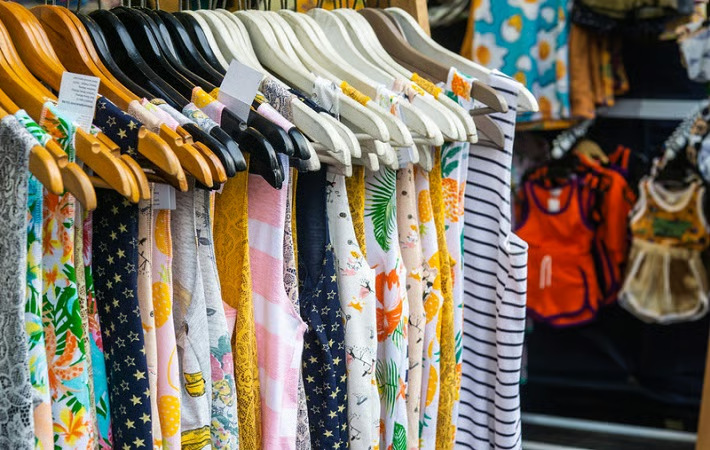
Nigeria imported textiles and textile articles worth N578.51bn in the first half of 2026, despite renewed efforts by the Federal Government and manufacturers to revive domestic production.
Data from the National Bureau of Statistics showed that textile imports increased by 2.2 per cent from N565.95bn recorded in the corresponding period of 2025.
The increase was significantly slower than the sharp growth recorded in the previous two years, when textile imports rose by 92.4 per cent in 2024 and 46.1 per cent in 2025.
Despite the slower growth, the value of imported textiles in the first six months of 2026 was higher than the full-year figures recorded in 2022 and 2023.
Nigeria’s textile and textile article imports rose from N365.46bn in 2022 to N377.47bn in 2023 before increasing to N726.18bn in 2024 and N1.06tn in 2025.
Speaking at the Industrial Revolution Work Group Technical Session II in Lagos, the Director-General of the Manufacturers Association of Nigeria, Segun Ajayi-Kadir, said the decline of the textile industry had significantly affected employment and production capacity.
“Textiles are an important area. During my first assignment in the Manufacturers Association of Nigeria, I was coordinating seven states from Abuja to Kaduna, which had seven textile industries. Today there is zero. So it tells the story,” he said.
Ajayi-Kadir said the industry previously employed about 25,000 workers, adding that the size of the domestic clothing market created an opportunity for local manufacturers.
“But the fact remains that everybody must wear something. So there is no need for us to overemphasise the fact that it is important and it is an area that we play,” he said.
He called for the revival of the cotton-textile-garment value chain, particularly through stronger domestic production and input supply.
“What we need to do is revive the cotton-textile-garment value chain input supply. And this is already being done,” Ajayi-Kadir said.
He also pointed to government procurement policies aimed at increasing demand for locally manufactured products.
“We must sign on to export facilitation and Made-in-Nigeria public uptake. To give effect to this, we’ve had the Made-in-Nigeria Executive Order, and it’s now supported by ‘Nigeria First’,” he said.
The Federal Government’s Nigeria First policy is intended to increase the use of locally produced goods in public procurement and strengthen domestic manufacturing.
The textile industry is one of the sectors being considered under the Industrial Revolution Work Group, particularly through its thematic group on Made-in-Nigeria patronage and anti-counterfeit measures.
The group is examining issues including smuggling, counterfeit products, public perception, standards infrastructure and procurement practices, as well as challenges affecting the textile, pharmaceutical and steel industries.
The continued importation of textiles also comes as industry stakeholders push for stronger local production capacity and wider access to domestic and export markets.
Bukola Ajani, President of the Association of Women in Fashion Tech, previously told The PUNCH that Nigeria’s textile industry was being reinvigorated and had the potential to serve consumers in other African countries and Europe.
For local manufacturers, however, the increase in imports means imported products continue to account for a significant share of the Nigerian textile market.
The N578.51bn recorded in the first half of 2026 also means imports are already more than half of the N1.06tn recorded for the whole of 2025.
The slower year-on-year increase therefore represents a moderation in the growth of textile imports rather than a reversal of Nigeria’s dependence on imported textile products.